



Price action trading has become the backbone of many successful forex routines because it focuses on what actually matters: the raw movement of price over time. Instead of layering indicator after indicator onto a chart, price action traders read the market itself and use those movements to anticipate what might happen next. For Australian traders who want to trade forex, indices, shares or commodities, this approach offers a clear and logical way to make decisions in markets that never stop moving.
What is Price Action Trading?
Price action trading is based on analysing the raw movement of price over time without relying heavily on indicators. As price action traders, we use raw price data to analyse and anticipate future price movement in financial markets. The strategy is built on logic and simplicity, removing the external noise that often distracts traders, including news, economics and fundamental data.
The concept is simple: price moves in patterns, and those patterns repeat because they reflect human behaviour such as fear, greed and hesitation. Price action trading helps predict market movements by spotting patterns, or signals, in the price movements of an underlying market. Rather than asking what an oscillator says, the price action trader asks what the market is actually doing right now on the chart.
Why Price Action Belongs in Your 2026 Trading Routine
Every year we see new traders arrive at NP Financials carrying a toolkit full of lagging indicators, only to discover that the most reliable information was on the raw chart all along. Price action is a powerful way of picking out and trading high probability opportunities in the market, and it works across timeframes, asset classes and market conditions.
For Australian traders, that flexibility matters. The forex market trades around the clock, which means a strategy that depends on fixed news windows or specific trading sessions can leave you waiting for opportunities. Price action keeps the analysis on the chart in front of you, which makes it practical for traders juggling a day job, family life or other commitments.
The Core Price Action Patterns to Master
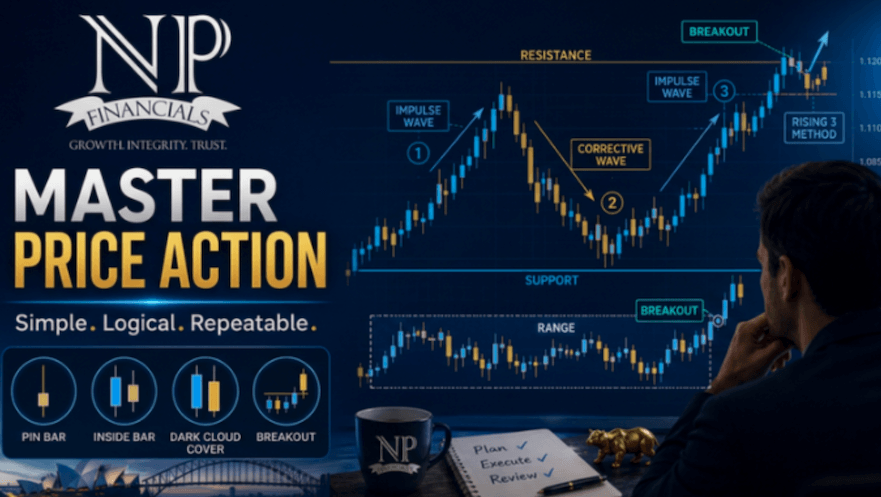
During our one-on-one mentoring sessions at NP Financials, we encourage traders to master a small set of reliable patterns rather than chase every chart formation they find online. Reliable price action patterns include inside bars, pin bars, engulfing candles, breakouts and retests, trend pullbacks and range reversals. Learn these well and you have a complete decision-making framework.
Pin Bars and Inside Bars
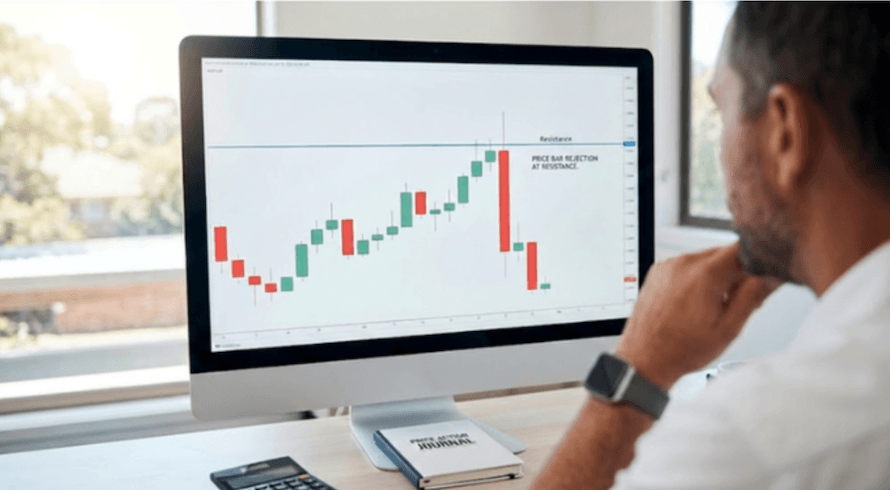
A pin bar forms when price pushes strongly in one direction and then closes back near its opening level. It signals rejection of a price level and can mark a potential turning point. An inside bar forms when the high and low of one candle sit inside the high and low of the previous candle. It signals a pause in activity, usually before a breakout. Both patterns appear regularly on forex charts and are simple to spot once you know what you are looking for.
Engulfing Candles
An engulfing candle opens beyond the previous candle’s close and closes beyond its open, in the case of a bullish engulfing pattern, or the reverse for a bearish one. The pattern shows a sudden shift in control from sellers to buyers, or buyers to sellers. Engulfing candles work best when they appear at meaningful support or resistance levels, rather than in the middle of nowhere.
Breakouts and Retests
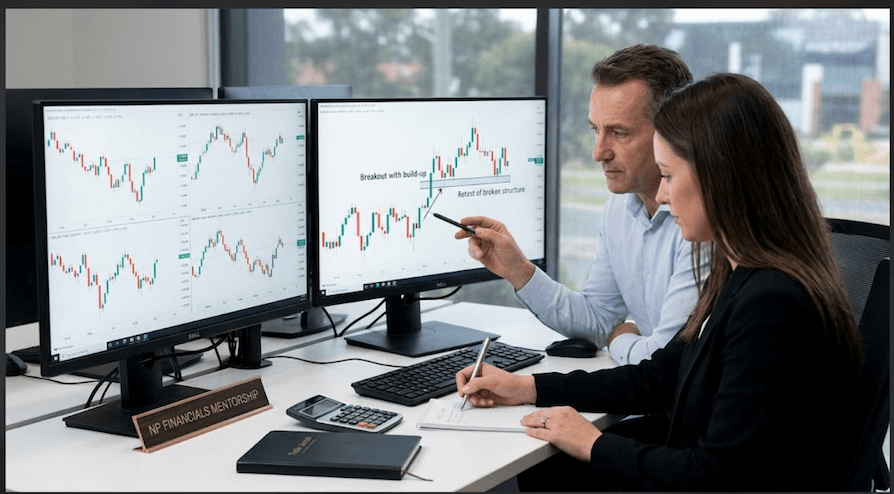
Breakouts occur when price moves beyond a defined level of support or resistance. There are several ways to trade them. A breakout with a build-up shows accumulation before price finally breaks. A pre-breakout setup positions you ahead of the move. A break of structure signals that the existing trend has shifted. The retest, where price returns to the broken level and bounces off it, is often the cleanest entry of all.
Trend Pullbacks and Range Reversals
Trading on price action involves analysing trending waves and pullback waves, also known as impulse and corrective waves. In an uptrend, you wait for a corrective pullback to finish and then enter in the direction of the prevailing impulse wave. In a range-bound market, you trade the reversals at the boundaries of the range. The key skill is identifying whether the market is trending or ranging, because the strategy you use depends on it.
Advanced Price Action Techniques for 2026
Once the core patterns feel natural, the next step is reading market structure at a deeper level. This is where many traders move from copying setups to genuinely understanding the market.
Impulse and Corrective Waves
Every trending move consists of impulse waves, which move in the direction of the trend, and corrective waves, which move against it. The impulse wave shows where the conviction sits and the corrective wave shows where the market pauses. By mapping these waves on your chart, you can time entries that sit in the direction of the larger move while using the correction as your point of entry.
False Breaks and Break of Structure
A false break happens when price pierces a level and then quickly reverses back inside the range. Many experienced traders treat false breaks as stronger signals than the original level itself, because they reveal where the big players are defending a price. A break of structure, by contrast, confirms that the prior high or low has been taken out and that the market is transitioning into a new phase. Combining both techniques gives you an edge when the market is deciding where to go next.
How to Build a Price Action Strategy
Building a price action strategy is not about collecting patterns. It is about creating a repeatable process. Start with a daily or four-hourly chart and mark the key levels of support and resistance. Then wait for one of the reliable patterns to appear at those levels. Finally, define your stop loss, your target and the maximum amount of your account you are willing to risk on the trade.
At NP Financials, we see traders make the fastest progress when they follow this structure consistently for three to six months. The beginner-friendly price action strategies we teach in our full course are designed to get traders towards profitability within that window, provided they put in the daily practice. Consistency matters more than complexity.
What We Notice Watching Australian Traders Learn
Since NP Financials was founded in 2013, we have trained more than 33,000 individuals globally. That experience has given us a clear view of the habits that separate progressing traders from those who stay stuck. The traders who improve treat price action as a skill to be coached, not a secret to be found. They take one-on-one guidance, review their trades honestly and work on trader psychology alongside their technical skills.
The traders who struggle tend to jump between strategies every week, add too many filters and avoid keeping a trade journal. Price action rewards patience and repetition. The same pattern traded fifty times teaches you more than fifty different patterns traded once.
Our master classes, real-time trade ideas and daily market insights are designed around that observation. We pair structured education with the kind of practical feedback that turns a beginner into a confident, independent trader.
Risk Management Remains Non-Negotiable
No discussion of price action strategies is complete without addressing risk. CFDs are complex instruments and come with a high risk of losing money rapidly due to leverage. You should ensure you fully understand the risks involved before trading. Price action improves your entry and exit decisions, but it cannot protect you from poor position sizing, over-leveraging or emotional revenge trading. Risk management is the foundation that allows price action patterns to work in your favour over the long term.
Learn Price Action with NP Financials
Price action trading is more than a collection of candlestick patterns; it is a complete approach to reading and responding to the market. If your goal is forex, shares, indices, commodities, intraday or cryptocurrency trading, the same raw price principles apply. NP Financials offers one-on-one courses and mentorship programs that teach people how to trade these markets, making the skill accessible for beginners and experienced traders alike.
If you are ready to build a reliable price action routine for 2026, join our course at https://npfinancials.com.au/forex-trading/ or contact us at +61 3 9790 9476 or info@npfinancials.com.au. You can also visit us at Level 3, 2 Brandon Park Drive, Wheelers Hill, Victoria 3150, Australia.
Frequently Asked Questions
What is a price action strategy?
A price action strategy is a trading approach based on analysing the raw movement of price over time without relying heavily on indicators. Traders use raw price data to spot patterns and signals in price movements and anticipate where the market may go next. It focuses on logic and simplicity, with the chart as the primary source of information.
Which is the best price action strategy?
There is no single best strategy that suits every trader. Reliable price action patterns include inside bars, pin bars, engulfing candles, breakouts and retests, trend pullbacks and range reversals. The best approach is to master a few patterns that fit your schedule and risk tolerance, then practise them consistently over several months.
Can I make $100 a day day-trading with price action?
Making a consistent daily income from day trading is possible in theory, but it depends heavily on your account size, risk management and skill level. CFDs are complex instruments and come with a high risk of losing money rapidly due to leverage. Focus first on building a repeatable price action routine before chasing any daily profit target.
Do I need news and indicators to trade price action?
No. Price action trading is based on analysing raw price movement and removes external noise including news, economics and fundamental data. Indicators are optional and many price action traders use none at all. The raw chart provides enough information to identify high probability setups when you have been trained to read it properly.
